





Bengaluru’s water utility consistently loses two critical resources — water and money.
Roughly one-third of the water entering its pipeline network never reaches end consumers. Simultaneously, the utility reportedly loses around Rs 80 crore every month.
One feeds the other.
Leakage reduces revenue. Revenue constraints limit infrastructure upgrades. Deferred maintenance increases leakage.
After a decade of this cycle, causality becomes blurred.
The Growing Dependence on Tankers
As summer approaches, households across Bengaluru — particularly along the IT corridor — brace for supply uncertainty.
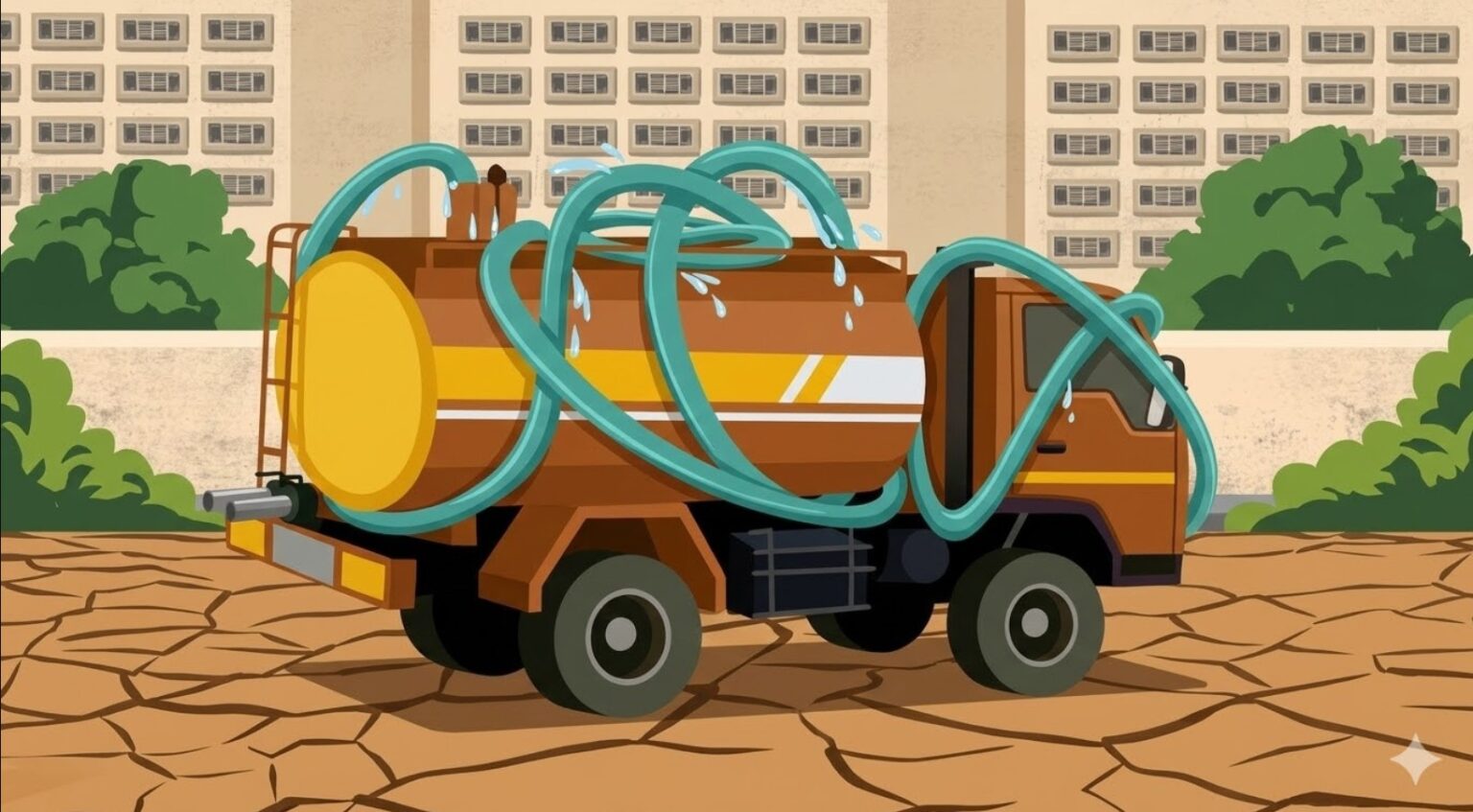
The gap between demand and municipal supply is increasingly filled by private water tankers.
For many residents:



- Borewells are declining in yield
- Groundwater extraction is rising
- Tanker deliveries have become routine rather than emergency support
But the tanker system itself has evolved into an economic ecosystem with pricing power.
Critics often describe parts of it as a “tanker mafia” — a loosely regulated market where supply constraints allow price premiums.
The Policy Response: Expand Tanker Supply?
Authorities often respond to shortages by increasing tanker deployment.
The logic appears straightforward:
- If pipelines fail, trucks deliver
- If groundwater falls, transport water from alternative sources
However, scaling tanker reliance introduces structural risks:
- It normalises inefficiency instead of fixing leaks
- It discourages long-term pipeline investment
- It deepens dependency on expensive logistics
More tankers may alleviate short-term shortages — but they rarely address root infrastructure problems.
Why the Utility Is Struggling
The financial pressure on Bengaluru’s water authority stems from multiple factors:
1. Transmission Losses
Old pipelines, leakages, and illegal connections reduce system efficiency.
2. Revenue Mismatch
Tariffs often fail to cover the true cost of extraction, treatment, and distribution.
3. Rapid Urban Expansion
Population growth and high-rise development increase water demand faster than infrastructure expansion.
4. Groundwater Depletion
Over-reliance on borewells accelerates aquifer decline — reducing resilience during drought cycles.
The result is a system that operates under permanent stress.
The Economic Consequence
When utilities lose revenue, they borrow or defer maintenance.
When maintenance is deferred, leak rates rise.
When leak rates rise, more water must be sourced — often from expensive alternatives.
The financial loop becomes self-reinforcing.
At Rs 80 crore monthly losses, the fiscal gap is not marginal — it compounds annually.
Infrastructure vs. Band-Aid Solutions
Increasing tanker availability may prevent immediate crisis escalation.
But long-term resilience requires:
- Pipe network rehabilitation
- Smart leak detection systems
- Metering reforms
- Transparent tariff restructuring
- Wastewater recycling expansion
Cities that rely heavily on tanker logistics often treat symptoms rather than systemic inefficiencies.
The Bigger Urban Question
Bengaluru’s situation reflects a broader challenge facing rapidly urbanising Indian cities:
Growth outpaces infrastructure planning.
Private markets — like tanker operators — fill service gaps faster than public utilities can modernise.
But private substitution of public infrastructure rarely scales efficiently without regulation and integration.
What Happens Next?
If tanker dependence continues to grow:
- Water prices may rise further
- Groundwater extraction could accelerate
- Inequality in access may widen
If structural reforms succeed:
- Leakage reductions could restore revenue
- Infrastructure upgrades could reduce tanker reliance
- Long-term supply stability could improve
The difference lies in execution speed.
The Core Insight
Expanding tanker supply may offer temporary relief.
However, without fixing distribution inefficiency and financial leakage inside the utility itself, tankers become a recurring necessity — not a solution.
Bengaluru is not short of water alone.
It is short of system reform.