






The West’s drinking problem is no longer excess.
It is absence.
Across the United States and much of western Europe, alcohol consumption has either plateaued or begun to decline. An ageing demographic, rising health awareness, and a generational shift toward mindful living are reshaping demand curves.
Younger consumers are leading the reset. Surveys indicate a growing interest in moderation, emotional well-being, and reduced alcohol intake across markets such as Germany and the United Kingdom. The cultural symbolism of drinking is shifting — from lifestyle staple to discretionary indulgence.
But thousands of miles away, the story looks very different.
India is drinking more.
The Divergence in Numbers
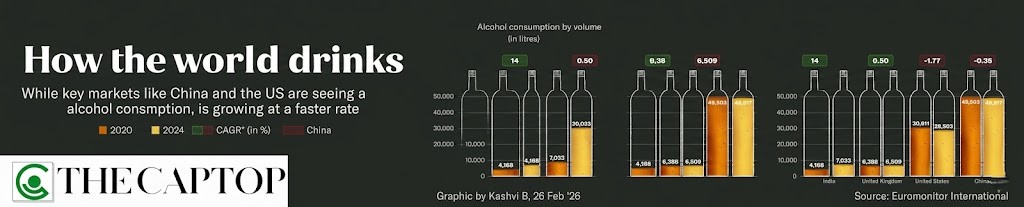
Between 2020 and 2025, India’s alcohol consumption expanded sharply — nearly 1.8 times by several industry estimates. While Western markets debate sobriety movements and zero-proof alternatives, India’s demand curve continues to tilt upward.
This is not merely a rebound story. It is structural.



Demographics: The Core Driver
Unlike Europe, which faces population ageing and stagnation, India remains one of the world’s youngest large economies. A substantial proportion of its population sits within the legal drinking age bracket.
Urbanisation compounds the trend. As consumers migrate to cities, lifestyle spending patterns evolve:
- Increased disposable income
- Higher exposure to global brands
- Rising social consumption occasions
Alcohol in India is gradually shifting from taboo to mainstream urban consumption.
Premiumisation Over Pure Volume
Another difference from Western markets lies in consumer aspiration.
While the US and Europe are seeing premium consumers trade down or switch to low-alcohol alternatives, Indian buyers are trading up. Premium whisky, craft beer, and imported labels are gaining traction among urban millennials and Gen Z consumers.
The narrative is not simply “more drinking.”
It is “better drinking.”
This premiumisation effect magnifies revenue growth even when per-capita consumption remains below Western averages.
Income Growth Meets Cultural Transition
India’s per capita income growth over the past decade has steadily expanded discretionary spending capacity.
Simultaneously, social attitudes are evolving:
- Alcohol is increasingly associated with networking and professional culture.
- Women consumers are entering the market in higher numbers.
- E-commerce and organised retail have improved distribution access.
Contrast that with Western markets, where public health messaging, wellness trends, and regulatory pressures are more mature and entrenched.
The Sobriety Movement in the West
In markets such as the US and UK, younger consumers are embracing alternatives:
- Low- and no-alcohol beverages
- Functional drinks
- Cannabis substitutes (in legal markets)
- Wellness-centric lifestyles
Alcohol is no longer central to identity formation. It competes with fitness culture, mental health awareness, and digital entertainment.
The shift is attitudinal, not cyclical.
Regulatory Paradox
India’s alcohol sector remains heavily regulated at the state level, with complex taxation structures. Ironically, high sin taxes have not dampened aggregate demand significantly. Instead, they have boosted state revenues and incentivised formalisation within organised players.
Meanwhile, in Europe, tighter advertising standards and social-health campaigns have exerted sustained downward pressure on consumption.
Is India Repeating the West’s Past?
The more provocative question is whether India is simply at an earlier stage of the same consumption cycle the West experienced decades ago.
Economic development historically correlates with increased alcohol demand — up to a point. After certain income and health-awareness thresholds are crossed, consumption patterns often stabilise or decline.
If that trajectory holds, India’s current upswing could represent a demographic dividend phase rather than a permanent structural divergence.
The Market Implication
For global beverage companies, the geographic centre of gravity is shifting.
Stagnation in mature Western markets increases strategic reliance on:
- India
- Southeast Asia
- Select African economies
India, in particular, offers scale, income growth, and premiumisation in one market.
That combination is rare.
The Larger Question
So why is India hitting the bottle while the world sobers up?
Because:
- It is younger.
- It is richer than before, but not yet saturated.
- It is urbanising rapidly.
- It is aspirational in consumption.
The West is moderating from maturity.
India is accelerating from emergence.
Whether that acceleration stabilises — or intensifies — will depend on how demographics, regulation, and wellness culture evolve over the next decade.
For now, the divergence is clear.
And global beverage balance sheets are taking note.
The CapTop Premium Insight:
Consumption trends rarely move in sync across development cycles. When mature economies reassess excess, emerging ones often embrace expansion. India’s alcohol surge is less rebellion — and more economic sequencing.