




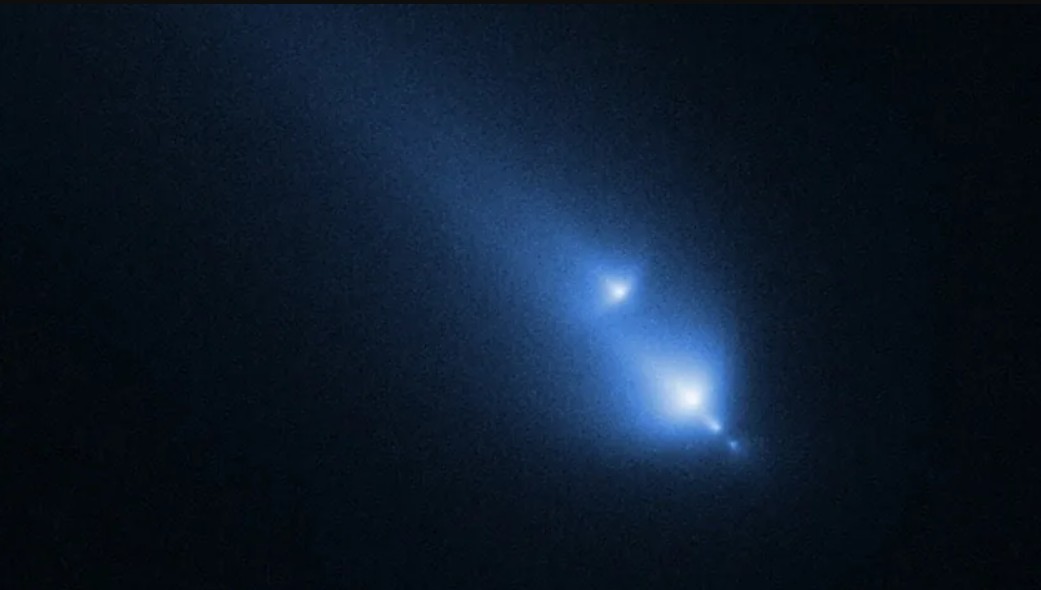

In a remarkable and unexpected breakthrough, NASA’s Hubble Space Telescope has captured something astronomers have been chasing for decades — a comet breaking apart in real time.
The object, officially named C/2025 K1 (ATLAS), revealed an extraordinary sight when scientists examined the images. Instead of a single comet, they found four separate fragments drifting through space, each surrounded by a glowing cloud of gas and dust.
“It was immediately clear this was something extraordinary,” said one of the researchers involved in the observation.
A Discovery Born by Chance
Interestingly, this historic observation wasn’t even planned.
The research team initially intended to study a different target. However, due to technical issues, they redirected Hubble toward K1 — a decision that led to one of the most significant comet observations ever recorded.
Such moments highlight how unexpected opportunities often drive major scientific discoveries.
Why This Matters: A Glimpse Into 4.6 Billion Years Ago
Comets are often described as cosmic time capsules, formed during the early stages of the solar system around 4.6 billion years ago.
Normally, scientists can only study a comet’s outer surface, which has been altered by radiation and solar heat over time. But when a comet breaks apart, it exposes pristine inner material — untouched since the birth of the solar system.
This makes such events incredibly valuable, offering insights similar to extracting a geological core sample from ancient Earth.
What Hubble Actually Saw
Hubble tracked the comet over three consecutive days in November, about a month after it passed closest to the Sun.
Each fragment displayed its own coma — a glowing halo formed when sunlight heats the ice, turning it directly into gas.
Researchers estimate:
- The breakup began roughly eight days before the first observation
- Another fragment split during the observation window
- The original comet may have been as large as a small city
A New Mystery Emerges
The discovery also raised new questions.
Ground-based telescopes noticed that the comet brightened later than expected. Scientists believe this delay could be due to how sunlight interacts with dust rather than freshly exposed ice.
There’s also early evidence suggesting the comet may have unusually low carbon levels, which could reshape existing theories about comet composition.
Where Did It Come From?
K1 likely originated from one of the distant regions of our solar system:
- Kuiper Belt — beyond Neptune
- Oort Cloud — a vast, theoretical shell extending up to 100,000 astronomical units from the Sun
These regions are believed to contain countless unseen comets.
A One-Way Journey
Now, the fragmented remains of K1 are drifting approximately 250 million miles away from Earth, heading out of the solar system.
Scientists say it will likely never return.
Final Takeaway
This rare observation marks a major milestone in astronomy. Capturing a comet in the act of breaking apart provides a direct window into materials that have remained unchanged for billions of years.
Sometimes, as researchers admit, the most important discoveries happen when things don’t go according to plan.